Sponsored article
Why Does the Timing of Cleaning After Thermal Cutting Determine Weld and Coating Quality?
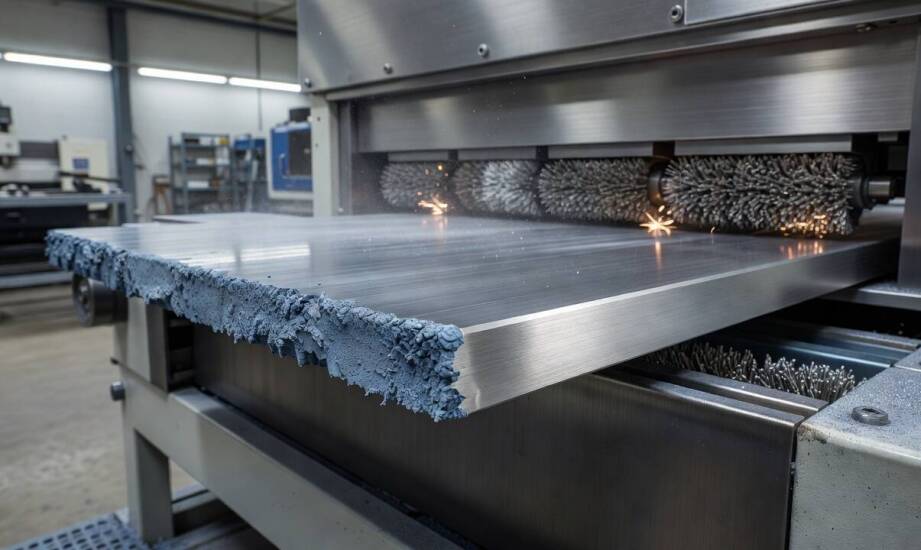
In modern manufacturing environments, a component leaving a thermal cutting table often appears ready for the next production stage. Smooth cut edges and precisely shaped contours can create the impression that welding, coating, or assembly operations can begin immediately.
However, the most significant issues frequently emerge later in the process when hidden edge defects start affecting material performance. Contaminants left on the cut edge, along with ongoing chemical reactions within the metal structure, can lead to welding defects and reduced coating adhesion.
Failure to remove scale and oxides often results in unnecessary production costs, requiring time-consuming rework on components that are otherwise nearly finished. For this reason, the final quality and durability of a steel part are largely determined by the moment when the cut edge is properly prepared for subsequent manufacturing operations.
What Happens to a Sheet Metal Edge After Thermal Cutting?
Laser and plasma cutting processes, particularly those using assist gases such as oxygen, initiate chemical reactions at the interface between heated metal and the surrounding atmosphere.
As a result, a hardened layer of oxides and mill scale forms along the cut edge, adhering tightly to the base material. If a newly cut component remains in storage for several days without further treatment, additional oxidation processes may begin.
The edge is constantly exposed to moisture and changing environmental conditions, which can gradually accelerate chemical degradation. Even stainless steel, commonly regarded as corrosion-resistant, may develop local corrosion spots when edge treatment is postponed for too long.
Over time, the oxidized layer becomes denser and forms a barrier with physical and thermal properties that differ significantly from those of the unaffected metal beneath it.
How Does a Lack of Edge Preparation Affect Welding?
The presence of oxides, hardened slag residues, and micro-burrs significantly changes the conditions under which welding is performed, regardless of the welding method used.
The scale layer typically exhibits a higher melting temperature than the surrounding steel. This immediately disrupts the formation of a stable weld pool and makes proper fusion more difficult.
Oxide contamination can hinder complete penetration of the base material and contribute to internal weld porosity. Trapped gases may form microscopic voids inside the cooling weld, reducing both mechanical strength and sealing performance.
When working with contaminated edges, welders often need to interrupt production to perform additional grinding and manual cleaning. Such interruptions reduce productivity and can negatively affect process consistency.
Changes to welding parameters that become necessary due to varying edge quality may also affect dimensional stability and repeatability in serial production.
How Do Oxides and Scale Reduce Paint Adhesion?
The same contaminants that interfere with welding can also create significant problems in painting, coating, and galvanizing operations.
Oxides, burrs, and embedded scale residues form an unstable surface for liquid coatings and powder coating systems. During application, coating particles may adhere to the outer oxide layer rather than directly bonding to clean steel.
During later service life, even moderate mechanical loads and normal temperature fluctuations can cause coating failure if the substrate was insufficiently prepared.
Mechanical stress and temperature changes may lead to coating detachment together with poorly cleaned surface layers.
This is why effective preparation requires complete exposure of clean metal along the entire edge.
Proper and timely sheet metal cleaning supports uniform powder distribution, improves coating adhesion, and contributes to long-term corrosion resistance. According to industry practice, cleaning and grinding operations are recommended before welding, painting, and other finishing processes to ensure optimal results.
What Are the Benefits of Automating Sheet Metal Cleaning?
Removing these defects solely with handheld angle grinders may be sufficient in low-volume production, but the approach becomes increasingly inefficient as production volumes grow.
At larger scales, manual processing inevitably introduces variability, leading to inconsistent edge rounding, local overheating of the material, or uneven surface quality.
Automated cleaning and deburring systems address these challenges by applying uniform processing pressure across every part of the workpiece.
As demonstrated by industrial deburring and cleaning technologies, automated systems can remove scale, smooth sharp edges, and prepare the material surface for downstream operations in a single pass. This provides greater consistency and repeatability than manual methods.
Modern production lines help maintain continuous flow between cutting, welding, and coating stations while reducing the risk of operator-dependent variations.
Consistent Surface Preparation Means Consistent Product Quality
Achieving repeatable quality in steel fabrication depends heavily on maintaining strict timing between individual production processes.
By removing oxides and hardened scale immediately after thermal cutting, manufacturers can significantly reduce the risk of deeper corrosion initiation and structural inconsistencies. Early edge treatment also helps stabilize subsequent manufacturing stages and limits the need for corrective operations.
Automated processing systems further support efficiency by eliminating bottlenecks associated with manual rework stations. This creates a smoother workflow and reduces downtime across the production chain.
Madora specializes in the design and manufacture of deburring, deslagging, and sheet metal processing machines that support the preparation of metal surfaces for further production operations.
Properly timed and mechanically controlled edge preparation supports stable welding parameters while simultaneously improving the long-term durability of protective coatings. For many manufacturers, it remains one of the most effective ways to improve product quality and reduce overall production costs.
You might be interested

Aluminium entrance mats – how do you customise them?
Aluminium entrance mats combine aesthetics and functionality to influence the first impression of visitors. Thanks to the variety of products available and the customisation options, they can be tailored to individual customer needs. It is noteworthy for its use both indoors and outdoors, making it

Religious vestments in various congregations – an overview and comparison
Religious vestments have for centuries been a sign of belonging to a specific community and an expression of adopted spirituality. Their appearance, color, and way of being worn result from the traditions of a given congregation, the religious rule, and the history of the community. Although many ha